
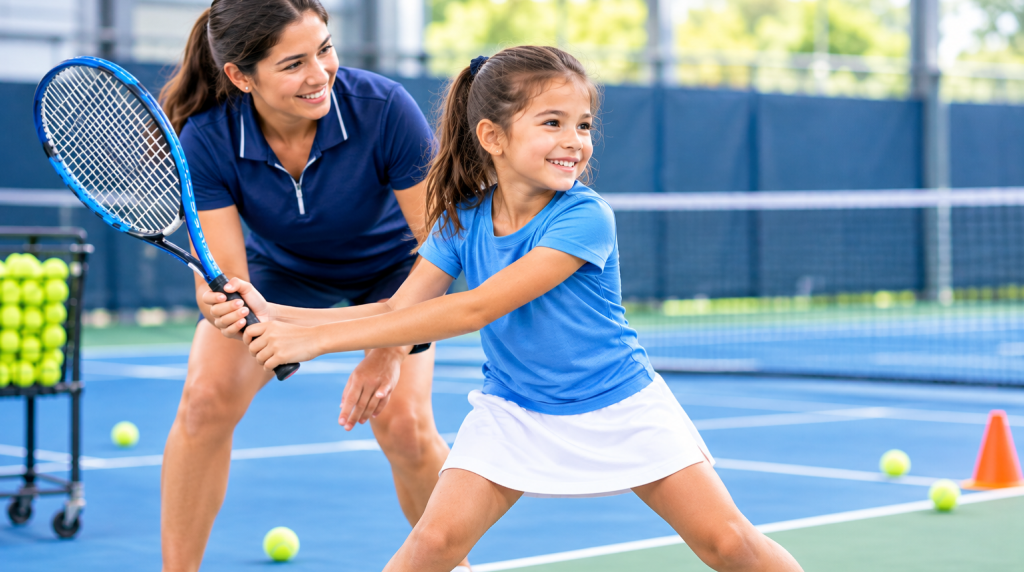
Both usually show up, but not just because kids hit a lot of balls. They show up because of how a good coach designs the hour. Here’s what actually happens on court, and why it works.
If you’ve ever watched a beginner tennis lesson from the sidelines, you may have noticed how little of it looks like “real tennis.” There’s a lot of bouncing, catching, hopping, and laughing, and surprisingly few full swings.
That isn’t a coach filling time. It’s the method. Kids tennis coaching is built on a simple idea: a child who moves well and feels capable will keep playing, and a child who keeps playing will get good.
This post walks through how a tennis coach for kids builds coordination, how the same sessions quietly build confidence, and what to look for when you’re choosing a program. It’s about what the coach does, not just what the sport does, so you’ll know what good coaching looks like when you see it.
What Kids Tennis Coaching Actually Looks Like
A well-run lesson for young beginners usually has four parts, even if the kids never notice the structure.
It starts with a warm-up that feels like a game: tag variations, hopping patterns, balance challenges, running to touch a cone and back.
Then comes a short skill block, typically one focus per session, such as hitting a bounced ball forward or moving to the ball with small, quick steps. After that, the coach moves into a game or point-play format that lets kids use what they just practised, often with the scoring adjusted so everyone gets plenty of turns. The session usually closes with a short cool-down and a quick word about what went well.
While all of that is happening, a good coach is watching things most parents don’t think to look for. How is the child holding the racquet?
Are they balanced when they make contact, or leaning back on their heels? Do they watch the ball all the way in, or glance away at the last second? And just as important, how do they react after a miss? Do they shrug and try again, freeze up, or wander off to look at the ceiling?
Those observations drive the next session. That’s the real difference between coaching and simply feeding balls to a child. The coach is running a quiet experiment on each kid, adjusting the challenge so it’s hard enough to be interesting and easy enough to be winnable.
How Tennis Coaching for Kids Builds Coordination
Coordination isn’t one skill. It’s a bundle: balance, timing, tracking a moving object, and getting your hands and feet to cooperate.
Tennis happens to ask for all of them at once, which is why structured tennis training for kids is such an efficient way to build them. But kids don’t absorb coordination just by being near a racquet. It comes from how the coach sequences the work.
Grip and Stance: Where Coordination Starts
Everything in tennis begins at the hand and the feet. A coach will usually teach a simple, comfortable grip first, then check it again every lesson, because small hands drift.
A grip that’s too tight makes the wrist stiff and slows the swing. A grip that’s too loose lets the racquet twist on contact.
Stance gets the same attention. Most coaches teach a “ready position” very early: feet about shoulder-width apart, knees softly bent, weight on the balls of the feet, racquet out in front.
It looks simple, but it’s the launch pad for every movement that follows. A child who starts each point balanced can move in any direction. A child who starts flat-footed is already late.
Good coaches also resist the urge to correct everything at once. One change per session is plenty for a six-year-old. The grip fix this week, the stance fix next week. Coordination builds in layers, and the layers need time to settle.
Footwork and the Ready Position
If you ask a tennis coach what separates kids who rally well from kids who struggle, many will say footwork before they say swing. Kids who reach the ball in a balanced position have a decent chance of hitting it. Kids who reach for the ball with their arm alone usually don’t.
That’s why early lessons are full of movement games. Kids learn to take small adjustment steps, to push off one foot and recover, and to return to the ready position after every shot.
Coaches disguise this with ladders, cones, and short races, because a seven-year-old will happily run a footwork pattern if it’s framed as a challenge and almost never if it’s framed as a drill.
The payoff goes well beyond tennis. Balance, change of direction, and the ability to stop and start smoothly carry over to soccer, basketball, skating, and plain old playground life. A child who learns to move well on a tennis court tends to move well everywhere else too.
Red, Orange, and Green Ball Tennis: Progressions That Fit Small Bodies
One of the smartest things in modern kids tennis coaching is that nobody expects a six-year-old to play on an adult court with an adult ball. Instead, the game is scaled to the child.
This is called progressive tennis, and Tennis Canada explains that it was designed to scale the game down for kids 10 and under so the techniques and tactics can be experienced in ways that suit their size and skill.
The system uses three stages, usually identified by ball color:
- Red: the starting point, for roughly 8 and under. It uses a short court, a low net, and a large, soft ball that moves slowly and bounces low.
- Orange: the middle step, for roughly 9 and under. The court is longer and the ball is a bit livelier, at about half the compression of a regular yellow ball according to Tennis Canada.
- Green: the final step before the full game, for roughly 10 and under. It’s played on a full-size court with a ball at about three quarters of a regular ball’s compression.
Exact age bands vary a little from program to program, and a coach may move a child up or hold them back based on skill rather than birthdate. Court sizes vary slightly too, but the pattern is the same: a short court for red, a mid-size court of roughly 60 feet for orange, and the full 78-foot court for green.
Why does this matter for coordination? Because a slower, softer ball gives a child more time to see it, get set, and swing. More time means more clean contacts.
More clean contacts means the brain wires the movement correctly rather than learning to flail. When you’re comparing programs, ask whether the coach uses a ball and court progression. If the answer is a confident yes and a clear explanation, that’s a good sign.
Hand-Eye Coordination Drills Kids Actually Enjoy
Hand-eye coordination is the heart of tennis, and the best drills rarely look like drills. A few that coaches commonly use with young beginners:
- Bounce and catch. The child bounces a ball and catches it with a racquet, a hand, or a small basket. It builds tracking and gentle control.
- Bounce and hit. The child lets the ball bounce once, then taps it forward over a low net or between two cones. It teaches timing without the pressure of a fast incoming ball.
- Balloon tennis. A balloon floats slowly, so even the youngest kids get plenty of successful hits. It’s a favourite with kids under six.
- Target games. Hoops, cones, or buckets become targets. Aiming turns a swing into a puzzle, and kids concentrate harder when there’s something to hit.
- Shadow swings. Practising the movement without a ball helps kids feel the motion before they add the timing challenge.
You’ll notice that nothing on that list needs a big, fast, intimidating ball. The goal is repetition with success, which brings us to confidence.
How Kids Tennis Coaching Builds Confidence
Confidence in sport isn’t a personality trait kids either have or don’t. It’s a set of experiences that stack up: I tried something hard, I got better, and someone noticed. Good coaching is largely the craft of arranging those experiences on purpose.
Small Wins and Visible Progress
Think about what a beginner tennis lesson feels like from a child’s perspective. At the start, almost everything is hard. Hitting the ball at all is a win. A good coach knows this and designs the first weeks so that kids get lots of small, real wins in every session.
That might mean choosing a drill where most kids can succeed on most attempts, then raising the difficulty by a notch only when the child is ready.
It might mean using a short court so a rally of three hits feels like a triumph. It might mean pointing out something specific: “Last week you hit the ball twice in a row. Today you hit it six times.” Kids love that kind of evidence, because it’s undeniable. Nobody can tell them they’re not improving when the number is right there.
This is the core of beginner tennis coaching for kids: make progress visible. Children who can see themselves getting better tend to keep showing up, and children who keep showing up are the ones who end up feeling like tennis players.
Feedback That Builds Kids Up
What a coach says matters as much as what the coach teaches.
Research on youth coaching describes confidence as something fostered through experiences of mastery, perceived improvement, and supportive feedback from coaches, according to a peer-reviewed study of youth coaching practices. In plain terms, kids build belief in themselves when they succeed at something, notice they’re improving, and hear encouragement that feels earned.
The same study also noticed that coaches tend to rely on general feedback like “good job,” even though more specific, individual feedback may do more to build confidence.
That matches what many parents notice. “Good job” is nice, but “I loved how you moved your feet before you swung” is the kind of comment a child remembers on the car ride home.
Infographic Alt Text : showing a young girl playing tennis alone on a court, highlighting the benefits of kids’ tennis coaching, including confidence, coordination, focus, discipline, social skills, and physical health.
A few habits separate good feedback from the forgettable kind:
- Specific, not vague. Name the exact thing that worked.
- Effort before outcome. Praise the attempt, the focus, and the improvement, not only the result.
- One correction at a time. A child who hears five fixes in a row hears “you’re doing it wrong.”
- A quick reset. After a miss, a good coach gets the child back to the next try in seconds, with no lingering on the mistake.
If you’re sitting on the sidelines, listen for this. It tells you a lot about the coach.
Learning to Handle Mistakes and Lost Points
Tennis is a sport of constant, small failures. Even the best players in the world lose a big share of the points they play. For a child, that can be uncomfortable at first, and it’s one of the most valuable things the sport teaches.
A coach builds this skill gradually. Early on, the environment is arranged so that mistakes are cheap and recovery is easy: no scoreboard, no audience, no consequences.
As kids get more comfortable, the coach introduces light competition, like first to five points or a team game, and teaches a simple routine for resetting after a miss. Take a breath, check your feet, go again.
Over weeks and months, something shifts. The child who used to sulk after a missed shot starts shrugging and moving on.
That emotional skill is confidence in its most practical form: the belief that a mistake isn’t the end of the world and that effort leads somewhere. It shows up later in school, in friendships, and in every new thing they try.
Tennis Coaching for Shy Kids
Parents of quieter kids often worry that sport will be overwhelming, and with a big team environment that’s a fair concern. Tennis can be a gentler entry point.
The actual play is one on one, so there’s no hiding in a crowd and no pressure to coordinate with teammates, but lessons are usually taught in small groups, so a child still gets the company of other kids and the encouragement of a coach.
For a shy child, that mix is useful. They can build skills at their own pace, earn quiet wins, and let friendships form naturally around a shared activity.
Many coaches will also give a hesitant child a small job, like helping collect balls or leading a warm-up count, which builds a sense of belonging without forcing them into the spotlight.
If you’re weighing tennis against other activities for a reserved child, it’s worth reading how team and individual sports compare. Our post on the best sports for kids covers that question in more depth.
Private vs Group Tennis Coaching for Kids: Which Builds More?
Parents often ask whether private tennis coaching for kids is worth the extra cost, or whether group classes do the job. The honest answer is that they build slightly different things.
Group tennis coaching for kids is where many children thrive socially. They watch others try and fail, laugh together, and pick up energy from the group.
Games are more fun with more players, and a good coach can keep each child engaged through rotating drills. Group classes are also usually more affordable, which makes them an easy way to test whether a child enjoys the sport.
Private lessons give a child the coach’s full attention. Every swing gets seen, every habit gets caught early, and the pace can bend entirely around the child.
For a child who is struggling with one specific skill, or who feels self-conscious in a group, a short run of private sessions can be a real confidence boost. Some kids simply learn faster one on one.
Many families end up blending the two: group classes as the weekly foundation, with the occasional private lesson to work on a specific skill or to get ready for something new. Neither format is “better” in general. It depends on the child, the goal, and the budget.
How Long Until a Child Can Rally?
This is the question every parent secretly wants answered, and the honest answer is: it depends. Age, practice time, natural coordination, and temperament all play a part, and there’s no reliable fixed timeline.
What coaches commonly see is a pattern. In the first few sessions, kids focus on simply making contact and getting the ball to go roughly where they want. A handful of sessions later, many children can exchange a few hits with a coach on a short court with a soft ball.
Longer, steadier rallies take more time, especially as the court and ball get bigger. Progress isn’t a straight line. Some weeks feel like a breakthrough and others feel stuck, and that’s completely normal.
What matters more than speed is direction. If your child is a bit better this month than last month, and still wants to go back, the coaching is working.
It also helps to remember that starting age changes the picture. A five-year-old and a nine-year-old will move through the early stages at very different speeds, and neither is behind. Our post on the best age to start kids tennis lessons goes through what readiness looks like at each stage.
How to Choose a Kids Tennis Coach
Not every coach is right for every child, and a great player isn’t automatically a great teacher. Here’s what to look for when you’re choosing a tennis coach for your child.
Experience with young beginners. Teaching a distractible six-year-old is a different skill from coaching a motivated teenager. Ask how long the coach has worked with kids your child’s age, and what a typical first lesson looks like. You can meet the coaches at Champion Sports Academy to get a sense of what that looks like in practice.
A clear progression. Ask whether the program uses a ball and court progression, and how a child moves from one level to the next. A coach who can explain this simply usually has a plan.
A warm, patient tone. Watch a lesson if you can. Does the coach crouch to a child’s level, use their name, and stay calm when things go wrong? Kids notice the mood of a session instantly.
Sensible group sizes. Smaller groups mean more individual attention. Ask how many kids are in a typical class and how many coaches or assistants are on court.
Equipment sized for kids. A racquet that’s too long or heavy is one of the most common reasons a child struggles. A good program makes sure the equipment fits the child, not the other way around.
Communication with parents. You should hear what your child is working on and how they’re progressing, in plain language and without jargon.
A trial lesson. The best test is always a lesson. Let your child try, and then ask them how it felt, not just whether they liked it. A child who says “I want to go back” is giving you the most useful review you’ll get.
Credentials matter too, and it’s reasonable to ask about a coach’s certifications and any safe-sport or first aid training. But in practice, the coach’s ability to connect with kids tends to matter more than a long list of qualifications.
Kids Tennis Coaching in London, Ontario
If you’re a parent in the London, Ontario area, Champion Sports Academy runs junior tennis programs designed around beginners, with coaching that focuses on fundamentals like grip, footwork, and fun rather than rushing kids into competition.
Because London winters are long, having an indoor option means your child’s coordination and confidence don’t have to take a break when the snow arrives, and a regular weekly session can build real momentum through the colder months.
If you’re still working out whether tennis is the right fit, remember that you don’t have to commit to anything big up front. A first lesson is simply a chance to see how your child responds.
Ready to See What Tennis Coaching Can Do for Your Child in London, Ontario?
Wondering how your child would take to tennis?
Book a trial junior tennis class at Champion Sports Academy and let our coaches show you how a first lesson builds coordination and confidence from day one. We’re happy to answer questions about age groups, class levels, and what to bring.
Frequently Asked Questions
What does a kids tennis coach actually teach?
In the early stages, mostly movement and basics: how to hold the racquet, how to stand and move in a balanced way, how to track and hit a slow ball, and how to play simple games. As a child progresses, the coach adds strokes like the forehand and backhand, then serving, scoring, and point play. Along the way, a good coach is also teaching focus, patience, and how to bounce back from mistakes.
Is private tennis coaching worth it for a child?
It can be, especially for a child who needs extra help with one skill, who feels shy in a group, or who wants faster progress. For many beginners, group classes are a better starting point because they’re more social and more affordable. A mix of both often works best.
What size racquet does my child need?
Junior racquets come in a range of lengths, typically measured in inches, and the right size depends on your child’s height and strength, not just their age. A racquet that’s too big makes it hard to control the swing. The simplest approach is to have the coach check the fit in person, since sizing takes about a minute and avoids a common beginner problem.
Is tennis good for shy kids?
Often, yes. The play is individual, so there’s no pressure to rely on teammates, but classes are social enough that a child isn’t isolated. Quiet wins, clear feedback, and gentle responsibilities like helping with equipment can all build confidence at a comfortable pace.
Confidence Is Built One Rally at a Time
When you strip away the equipment and the lines on the court, kids tennis coaching is really about creating the right conditions for a child to grow. The ball and court get scaled to fit small bodies. The drills are designed so success comes often. The feedback is specific and kind. And the mistakes, which are inevitable, become practice in staying calm and trying again.
Coordination and confidence aren’t separate projects. They grow together. A child who moves better feels more capable, and a child who feels capable is willing to try harder things, which makes them move better still. That loop is what good coaching sets in motion, one rally at a time.