
Parents ask this question more than almost any other when they’re looking into tennis for their kids: what age should we actually start?
There’s no single magic number when it comes to the best age to start kids tennis lessons, but there is a range that works well for most families, and a few signs that tell you your child is ready before you even check a calendar. Here’s how to think about it.
What’s the Right Age to Start Tennis for Kids?
Most coaches agree kids can start structured tennis activities as early as age 3, though real skill-building typically kicks in around ages 5 to 7. The exact age matters less than the format: a 3-year-old doesn’t need drills and scorekeeping, they need games that happen to involve a racket. A 7-year-old is usually ready for something closer to an actual lesson.
So instead of asking “is my child old enough,” it’s more useful to ask “what kind of tennis experience fits my child’s age right now.”
Age-by-Age Breakdown: When Should Kids Start Playing Tennis
Ages 3–5: Introduction to Movement & Coordination
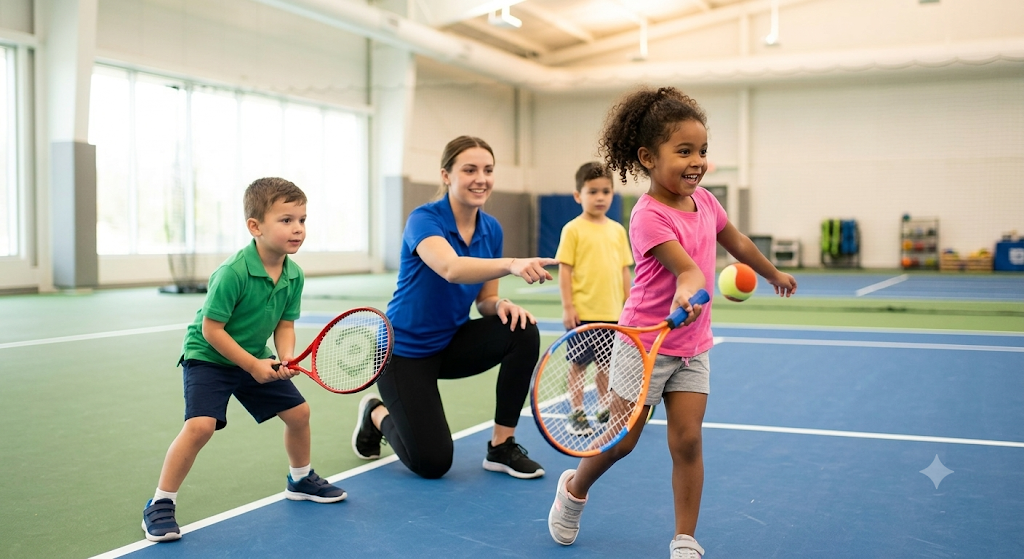
At this age, tennis lessons barely look like tennis. Kids are working on hand-eye coordination, balance, and following simple instructions in a group setting, things like tossing a ball back and forth, tapping a balloon with a small racket, or hitting off a stationary tee. The goal is comfort and fun, not technique. If a class at this age involves more standing in line than moving, it’s probably not built for a 3- or 4-year-old’s attention span.
Ages 6–8: Building Fundamentals
This is where actual tennis fundamentals start to take shape. Kids at this age can usually hold a proper grip, understand the idea of rallying, and start learning forehands and backhands with a lighter racket and a slower, low-compression ball. Classes tend to run in short bursts, typically 30 to 45 minutes, since focus is still developing.
Ages 9–12: Skill Development & Competitive Readiness
By this range, most kids have the coordination and attention span to handle a full-length lesson and start working on consistency, footwork, and basic strategy.
Some kids in this age group start expressing interest in mini-matches or friendly competition, which is a good sign they’re ready for more structured coaching, not necessarily a tournament circuit.
This is also the stage where you’ll start to see real differences between kids based on how long they’ve been playing rather than just their age.
A 10-year-old who started at 5 will often look noticeably more advanced than one just picking up a racket for the first time, and that’s completely normal.
It says more about time on court than natural ability. Coaches at this level usually start introducing full-court play, scoring, and match etiquette, since kids this age are generally ready to understand the “why” behind the rules, not just the mechanics of a swing.
Why Age Isn’t the Only Factor in Kids Tennis Development
It’s worth saying plainly: two kids of the same age can be at completely different starting points. A 6-year-old who’s spent years in gymnastics or swimming may have coordination and body awareness well ahead of a same-age peer trying a racket sport for the first time.
On the flip side, a naturally cautious kid might need an extra season in the group beginner class before a coach nudges them toward anything more structured.
This is one of the reasons a good junior program pays as much attention to skill level as it does to birth year. Age gets a child in the right general age bracket; the coach’s read on their comfort, coordination, and attention span decides what actually happens in that first lesson.
Signs Your Child Is Ready for Tennis Lessons
Age is a starting point, but readiness shows up in behavior, too. A few things worth watching for:
- They can follow a two-step instruction (“run to the cone, then hit the ball”)
- They can catch and throw a ball reasonably well
- They enjoy repetitive practice, at least in short stretches
- They’ve shown interest after seeing tennis, or asked to try it themselves
None of these need to be perfect. A kid who struggles with one of them isn’t behind, since coaches account for this constantly, which is part of why age-appropriate group sizes matter so much.
Group Classes vs. Private Lessons: Which Is Better for Young Beginners?
Group classes tend to work well for younger kids because the social element keeps things fun, and there’s less pressure on any one child to perform. Private lessons make more sense once a child has some baseline skills and is working toward something specific, like cleaning up a serve, correcting a grip issue, or preparing for more competitive play.
A common approach that works for a lot of families: start in a small group setting to build comfort and basic skills, then add a private lesson later if a coach flags something specific to work on, or if your child wants faster progress than a group pace allows.
There’s also a budget and scheduling side to this decision that’s worth being honest about. Group classes are generally more affordable per session and easier to fit into a recurring weekly routine, which matters if you’re not sure yet how committed your child will be.
Private lessons cost more per hour but compress progress into less time, which can be worth it if you’re working around a tight schedule or trying to address one specific issue, like a serve motion that’s developed a bad habit, or footwork that isn’t keeping up with faster rallies.
Some families land on a hybrid: a weekly group class for the social side, plus a private lesson every few weeks as a tune-up.
Common Mistakes Parents Make When Starting Kids in Tennis
Starting with adult-sized equipment.
A full-length racket is heavy and awkward for small hands, and it slows down technique development more than people expect. Junior rackets are sized by age for a reason.
Treating early lessons like training for competition.
Pushing a 5-year-old toward match play before they’ve built basic coordination usually backfires. Kids lose interest fast when something feels like work instead of play.
Skipping the “why” conversation.
Kids who get dragged to lessons without any buy-in tend to check out quickly. A short conversation about what tennis actually is, and letting them watch a bit of it first, goes a long way.
Assuming one bad first lesson means tennis isn’t for them.
New environments, new coaches, and unfamiliar kids can all make a first session rocky. Most coaches will tell you it often takes two or three sessions before a young child settles in.
Comparing progress to other kids too early.
It’s tempting to measure your child against a classmate who picks things up faster, but at this age the gap usually closes on its own with consistent, low-pressure practice. Kids tend to notice, and absorb, a parent’s frustration faster than they notice their own skill gaps, so this comparison often does more harm than the slow progress itself.
What to Look for in a Kids’ Tennis Program
Not all junior programs are built the same way, and a few details make a real difference for young beginners:
-
Coaches experienced specifically with young kids:
teaching a 4-year-old and teaching a 10-year-old require genuinely different approaches
-
Age-appropriate equipment:
smaller rackets, lower-compression balls, and shorter court dimensions where possible
-
Reasonable class sizes:
smaller groups mean more individual attention and less standing around
-
Indoor courts:
removes weather as a factor, which matters a lot when you’re trying to build a consistent habit with a young child
-
A clear beginner-to-intermediate path:
so progress feels visible over time instead of repeating the same session indefinitely
Junior Tennis Programs in London, Ontario
At Champion Sports Academy in London, Ontario, junior tennis lessons are built around exactly this kind of age-appropriate progression: smaller class sizes, coaches who work specifically with young kids, and indoor courts that keep training consistent no matter the season. The academy also offers private lessons for kids who are ready for more individual coaching, along with adult tennis programs for families with more than one player on their radar.
FAQ
What age can a child start tennis?
Most kids can start simple, play-based tennis activities around age 3, with more structured lesson formats becoming appropriate from about age 5 or 6 onward.
Is 3 too young to start tennis lessons?
Not necessarily, as long as the class is designed for that age: short, game-based, and focused on coordination rather than technique or drills.
How long should a beginner tennis lesson be for kids?
For younger kids (ages 3–5), 30 minutes is usually plenty. Kids 6 and up can typically handle 45 minutes to an hour as their focus and stamina develop.
Private or group lessons: which is best to start?
Group lessons are usually the better starting point for young beginners, since the social setting keeps it fun. Private lessons make more sense once a child has some fundamentals and a specific skill to work on.
Do kids need special equipment to start tennis?
Yes, a properly sized junior racket and a lower-compression ball make a big difference in how quickly a young child develops good habits, compared to using adult equipment scaled down in name only.
How often should a young child take tennis lessons?
Once a week is a reasonable starting point for most beginners. It’s frequent enough to build muscle memory between sessions without overloading a young child’s schedule or attention span, and it leaves room to add a second session later if they’re enjoying it and progressing well.
Getting Started With Champion Sports Academy
Get in touch with Champion Sports Academy to learn more about junior tennis programs. And if your family’s interests go beyond tennis, the academy also offers pickleball, badminton, and basketball programs under the same roof.