
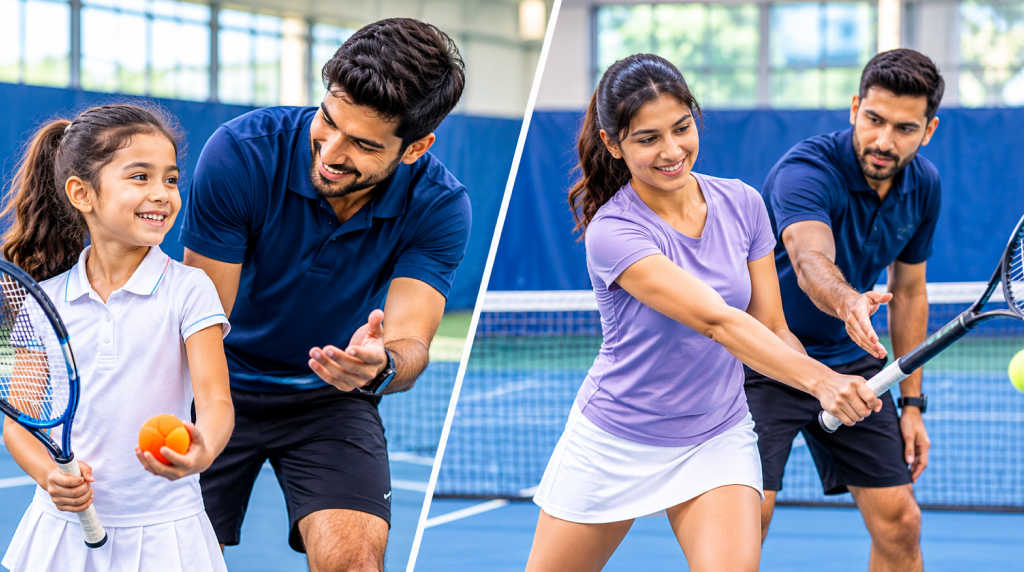
Junior tennis programs and adult tennis programs share the same sport, but they’re built very differently, because a seven-year-old and a thirty-seven-year-old learn, move, and stay motivated in completely different ways.
Junior programs focus on fun, coordination, and building skills at a pace that suits a growing body. Adult programs usually focus on technique, fitness, and enjoying the game.
Choosing well starts with understanding those differences. This guide walks through what each type of program looks like, seven key differences, the benefits of each, and how to choose the right one in London, Ontario.
What Are Junior Tennis Programs?
Junior tennis programs, sometimes called youth tennis programs, are structured lessons designed for children and young teens.
Good ones don’t shrink an adult lesson down to a smaller size. They rebuild it around how kids learn: short activities, games, plenty of repetition, and equipment that fits small bodies.
Age Groups in Junior Tennis Lessons
Most junior pathways group players by age and skill, often using red, orange, and green stages. Tennis Canada describes progressive tennis as a way to scale the game to a child’s size and skill, so young players can enjoy rallies sooner using adapted courts, balls, and racquets.
Champion Sports Academy’s junior pathway follows that idea with three levels: Red for ages 5 to 6, Orange for ages 7 to 10, and Green for ages 11 to 13, with one-hour sessions.
Age bands differ from program to program, and a good coach will place a child by skill and comfort rather than birthday alone. If you’re unsure when to start, our guide to the best age to start kids tennis lessons explains what readiness looks like.
Tennis Fundamentals for Children and Teens
Junior lessons build the basics in a sensible order: a comfortable grip, a balanced ready position, simple footwork, basic strokes, and short rallies.
Scoring and court etiquette come in gradually. The key is that skills are introduced as games and challenges, so children learn without feeling like they’re being drilled.
Benefits of Junior Tennis Coaching
A good junior program does more than teach strokes. It builds coordination, confidence, focus, and a love of being active. We cover each of these in more detail below.
What Are Adult Tennis Programs?
Adult tennis programs serve players from complete beginners to competitive adults. Adults come with different motivations than kids. Some want to try a new sport. Some are returning after years away.
Others want to fix technique, get fitter, or find people to play with. Good adult programs respect that variety and explain the “why” behind each skill.
Beginner Tennis Lessons for Adults
Beginner lessons are the easiest way into the game. Champion Sports Academy’s Level 1 Learn to Play program is intended for adults who want to learn, brush up, and enjoy themselves while meeting other players. According to the academy’s adult tennis page, it covers:
- Proper grip, ready position, and basic swing mechanics
- Fundamental footwork patterns for efficient court movement
- An understanding of topspin, underspin (slice), and serve techniques
- Keeping score and rallying with consistency
- An introduction to rules and match etiquette
The goal is for players to feel comfortable rallying and playing basic points with confidence by the end of the session.
Tennis Training for Intermediate and Advanced Adults
Once the basics feel solid, training shifts toward consistency, spin control, shot selection, and tactics. Intermediate players might work on depth and direction, serve placement, and handling pace.
Advanced players often focus on match play, doubles strategy, and refining weaknesses. The academy’s registration process lists beginner, intermediate, and advanced levels, so ask about current dates and offerings for your level.
Adult Tennis Skill Development and Fitness Goals
Many adults come to tennis for fitness as much as skill. Good programs keep both in mind, mixing technique work with movement and conditioning so players leave a session feeling like they’ve improved and exercised without it feeling like a workout.
Junior Tennis vs Adult Tennis Programs: 7 Key Differences
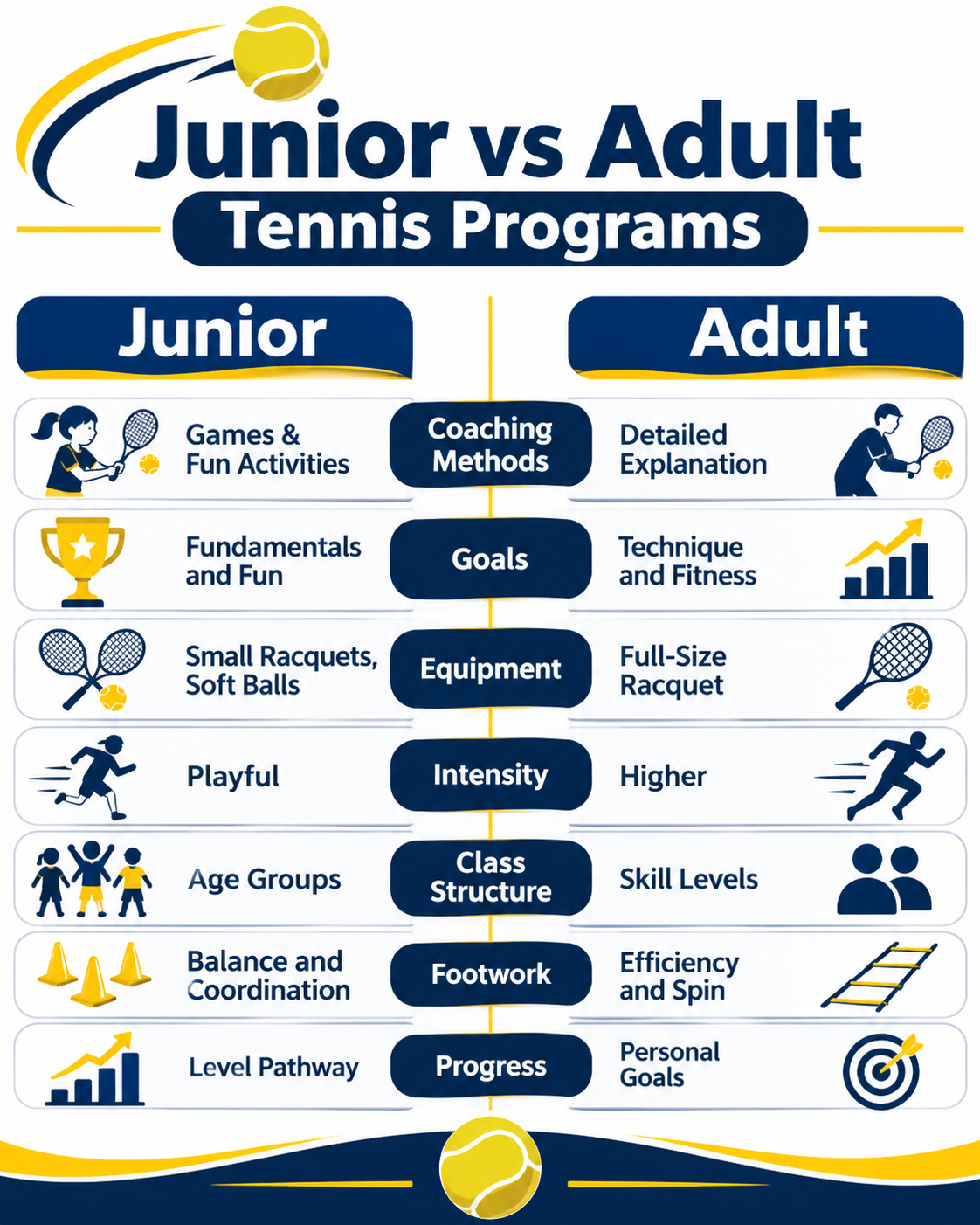
Here’s the comparison at a glance, followed by more detail on each point.
| Area | Junior Tennis Programs | Adult Tennis Programs |
| Coaching methods | Games, short activities, lots of encouragement | Explanation, technique breakdown, strategy |
| Goals | Fundamentals, coordination, confidence, fun | Technique, consistency, fitness, enjoyment |
| Equipment | Smaller racquets, lower-compression balls, modified courts | Full-size racquets, standard balls and courts |
| Intensity | Playful, built around short attention spans | Higher intensity, adjusted to fitness and health |
| Class structure | Age and skill groups, often small | Skill levels, often with social play |
| Footwork and technique | Basic movement, balance, simple strokes | Efficient footwork, spin, tactics |
| Progress tracking | Level-based pathway, skill checkpoints | Measured by consistency, match play, personal goals |
1. Age-Appropriate Tennis Coaching Methods
Kids learn best by doing, so junior coaches rely on games, short activities, and plenty of encouragement. Instructions stay simple, and sessions change pace often to hold attention.
Adults can follow longer explanations and often want to understand the reasoning behind a technique. Adult coaching leans on demonstration, feedback, and discussion, with a tone that treats players as capable beginners rather than as children.
2. Tennis Skills Development and Training Goals
Junior goals are about building a foundation: coordination, basic strokes, and a positive relationship with the sport. Adult goals are usually more specific.
A player might want to hit a more reliable backhand, improve their serve, or feel confident in a doubles match. Knowing the goal shapes everything from drills to pacing.
3. Tennis Racket and Equipment Requirements
Equipment is one of the biggest visible differences. Children use smaller, lighter racquets sized to their height and strength, along with lower-compression balls that bounce lower and move slower. Adults use standard full-size racquets and regular balls.
A racquet that’s too big or heavy makes learning harder for a child, so good junior programs make sure the equipment fits. Adults should still check grip size and weight with a coach, because a poor fit can strain the arm.
4. Training Intensity and Physical Conditioning
Junior sessions stay playful and are built around shorter attention spans, with rest built into the flow of games.
Adult sessions can run at a higher intensity, but they should also respect fitness level, previous injuries, and experience. A good coach scales effort for each adult in the group rather than pushing everyone equally hard.
5. Group Tennis Lessons and Class Structure
Junior classes are usually organized by age and skill, which keeps children playing alongside others at a similar level.
Small group sizes matter because young players need frequent, individual feedback, and Champion Sports Academy’s junior page highlights small group sizes.
Adult classes are organized by skill level and tend to include more social play, since many adults enjoy meeting people through the sport.
6. Tennis Footwork, Coordination, and Technique
Both groups need good footwork, but the emphasis differs. Juniors focus on balance, basic movement patterns, and building coordination. Adults often need to unlearn habits, improve efficiency, and add spin or tactical variety.
A child’s body is still developing, so coaches keep the technical demands realistic. An adult can usually handle more technical detail earlier, as long as the progression stays sensible.
7. Progress Tracking and Skill Development
Junior programs often use a level-based pathway with clear checkpoints, so children and parents can see growth. Adult progress is more personal: longer rallies, a steadier serve, comfortable scorekeeping, or enjoying a match without feeling lost.
In both cases, a good program makes progress visible and explains what comes next.
Benefits of Junior Tennis Lessons for Kids and Teens
Junior lessons give young players a lot more than a new skill.
Building Confidence Through Tennis
Confidence grows through small wins, specific feedback, and learning to handle mistakes. Every successful rally, even a short one, shows a child that effort pays off. For a closer look at how coaching builds this, see our post on how kids tennis coaching builds confidence and coordination.
Improving Coordination and Motor Skills
Tennis asks a child to track a moving ball, balance, and swing at the right moment, all at once. Practised regularly with age-appropriate equipment, that builds hand-eye coordination, agility, and body awareness that carry over to other sports and everyday play.
Developing Discipline and Teamwork
Showing up each week, listening to a coach, and practising skills teaches discipline. Group lessons and doubles add teamwork, communication, and good sportsmanship, like cheering for partners and accepting a call gracefully.
Encouraging an Active and Healthy Lifestyle
Kids who enjoy a sport are more likely to stay active. Tennis gives children a fun, structured way to get regular exercise, and it’s a sport they can keep playing for life.
Benefits of Adult Tennis Lessons for Beginners and Experienced Players
Adults benefit from tennis in different ways, and lessons help them get more out of each hour on court.
Improving Tennis Technique and Consistency
Many adults learn bad habits from casual play, like a tense grip or a late swing. Coaching spots those habits and replaces them with cleaner mechanics, which usually leads to more consistent shots and fewer frustrating errors.
Building Fitness, Agility, and Stamina
Tennis combines short bursts of speed with sustained movement, which makes it a good way to build fitness. The Canadian 24-Hour Movement Guidelines recommend that adults aged 18 to 64 get at least 150 minutes of moderate to vigorous activity per week, along with muscle-strengthening activities at least twice a week, and regular tennis can contribute to that total. For more on what the sport does for the body, read our post on the benefits of playing tennis for fitness and health.
Learning Tennis for Recreation and Competition
Some adults simply want a relaxed game with friends. Others want to join leagues or test themselves in matches. Lessons support both. A coach can tailor the focus to recreational play or match preparation, so you’re not forced into a path that doesn’t fit your goals.
How to Choose the Right Tennis Training Program for Your Age and Skill Level
The best program is the one that fits the player, not the one with the longest brochure.
Choosing Tennis Programs for Kids and Teens
Look for coaches who are experienced with children, equipment sized for kids, and a clear progression from beginner to more advanced levels. Check whether groups are small enough for real feedback.
Pay attention to the tone of a lesson: children should be encouraged, not pressured. For older teens, ask what the program offers beyond the junior pathway. Champion Sports Academy’s junior pathway currently runs through age 13, so private lessons may be worth asking about for older teens.
Finding the Right Adult Tennis Coaching
For adults, start with an honest look at your level and goals. A complete beginner should look for a Learn to Play style program, while returning players might want to start a little higher. Ask what skills each level covers, how many players share a court, and how progress is measured.
Group Lessons vs Private Tennis Lessons
Group lessons offer social play, practice partners, and a lower cost per session. Private tennis lessons give more individual feedback and a schedule built around you. Many players mix the two. For parents weighing options for a child, our guide to private tennis lessons for juniors explains what to look for in a coach.
Junior and Adult Tennis Programs at Champion Sports Academy in London, Ontario
Champion Sports Academy runs tennis programs for both juniors and adults at its indoor facility at London, Ontario., the programs are guided by certified coaches and designed for beginners through competitive players.
On the junior side, the pathway runs from Red (ages 5 to 6) to Orange (ages 7 to 10) to Green (ages 11 to 13), using age-appropriate equipment and small group sizes.
The academy says the focus is on fundamentals, proper technique, and building confidence in a supportive environment. Its junior page also mentions a free trial for new players, so ask about current availability.
For adults, the academy offers a Level 1 Learn to Play program for beginners, with a pathway designed from complete beginner through advanced play. The academy says its adult program uses the Progressive Tennis approach, which Tennis Canada and other industry leaders have identified as a best-practice methodology for adult tennis lessons. Private lessons are available for both juniors and adults.
Program dates, availability, and fees change, so confirm current details with the academy before you plan around them.
Frequently Asked Questions About Junior and Adult Tennis Programs
At What Age Can Children Start Junior Tennis Lessons?
There’s no single starting age. Many programs start around five or six, using small courts and soft balls, and readiness depends on coordination, attention span, and interest. Champion Sports Academy’s junior pathway begins at age 5.
Are Junior Tennis Programs Different from Adult Tennis Lessons?
Yes. Junior programs use games, smaller equipment, and shorter activities built around how children learn. Adult lessons use more explanation, standard equipment, and goals centered on technique, fitness, and enjoyment.
Can Beginners Join Adult Tennis Programs?
Yes. Beginner adult programs, such as a Learn to Play level, assume no experience and start with grip, stance, footwork, and basic strokes, so you can start from scratch.
Are Group or Private Tennis Lessons Better for Juniors?
Neither is better for every child. Group lessons are social and often more affordable, while private lessons offer focused feedback. Many families combine both, using group lessons as the regular routine and private lessons to work on a specific skill.
How Often Should Children and Adults Practise Tennis?
It depends on age, schedule, fitness, and goals. Many beginners start with one lesson a week and add practice or play between sessions. Children should have time for other activities and rest, and adults should build up gradually, especially if they’re new to exercise.
Can Adults Learn Tennis Without Previous Experience?
Absolutely. Adults of all ages start tennis from scratch. A good beginner program teaches the basics step by step, and most adults find they’re rallying within a few weeks of regular practice.
Choose the Right Tennis Program and Start Improving Your Game
Junior and adult tennis programs aim at the same sport but serve different needs. Junior programs build confidence, coordination, and a love of the game through play and age-appropriate coaching. Adult programs build technique, fitness, and enjoyment through clear instruction and goals.
If you have a child who might like tennis, consider a junior program built around their age and level. If you’re an adult, look for coaching that matches your experience and what you want from the game.
Whichever program you choose, the best sign is simple: a player who looks forward to the next lesson.
Ready to Start Tennis in London, Ontario?
Not sure which program fits you or your child? Book a consultation with the Champion Sports Academy’s junior tennis programs or adult tennis programs, then register or reach out to ask about current levels, dates, and availability.