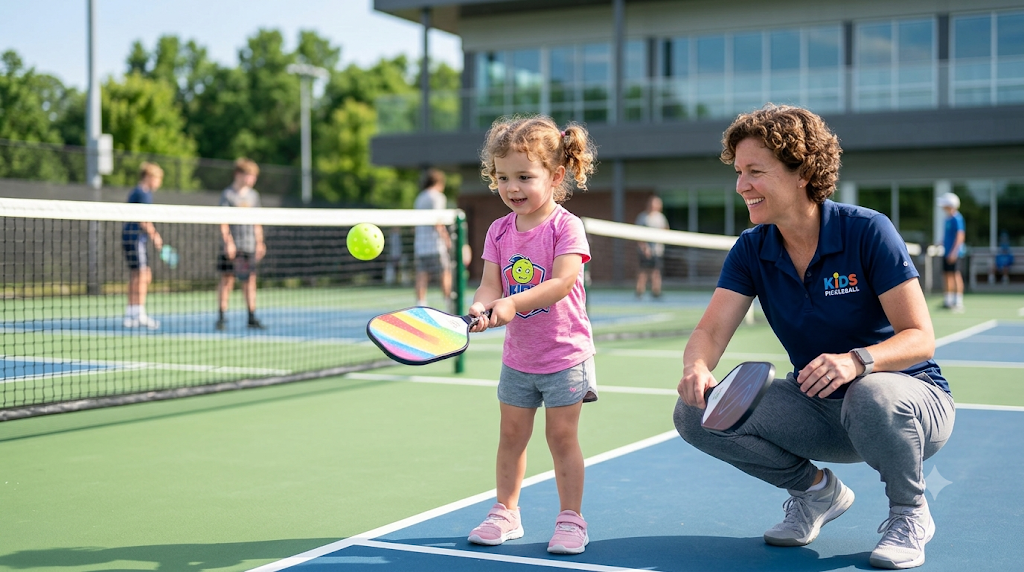
Pickleball isn’t just a trend for retirees anymore. Over the past few years, it’s become one of the fastest growing sports in Canada and one of the most popular first racquet sports for kids, and once you understand why, it’s easy to see the appeal.
The court is smaller than a tennis court, the paddle is lighter and easier to control than a full-sized racquet, and the ball moves slowly enough that kids can actually track it and hit it back without feeling like they’re constantly failing. That combination matters a lot for a child who is just starting out.
This guide walks through what a pickleball lesson for kids typically covers, the real benefits beyond just “it’s fun,” the skills your child will actually build, and what to expect from that first session on the court.
Why a Pickleball Lesson Is a Great First Racquet Sport for Kids
A lot of parents default to tennis as the obvious first racquet sport, but pickleball genuinely deserves more consideration than it usually gets. Because the court is smaller and the ball travels slower, kids can work on hand-eye coordination and movement patterns without the frustration that sometimes comes with a faster-paced sport like tennis. Rallies start sooner, which means a child gets more early success, and more early success tends to mean more fun and less of the discouragement that can turn a kid off a sport before they’ve really given it a chance.
It’s also a sport that scales well. A child can start with basic paddle control and simple rallies in their first pickleball lesson, then gradually build toward better footwork, strategy, and match play as they grow more comfortable.
The Real Benefits of a Pickleball Lesson for Kids
The benefits go well beyond simply keeping a child active for an hour. Here’s what actually develops through consistent lessons.
Better Hand-Eye Coordination and Reaction Speed
Every shot in pickleball requires a child to track the ball’s flight, judge where it will land, and time their paddle contact correctly. That combination builds hand-eye coordination in a very direct, immediate way, since a child has to react in real time rather than waiting passively for the action to come to them the way they might in a larger team sport. Coaches who work with youth players have noted that pickleball helps children develop fine motor skills and spatial awareness in a setting that feels more like play than formal training.
A Low-Impact Sport That’s Easy on Growing Joints
Compared to many traditional youth sports, pickleball places relatively little strain on a child’s body. The smaller court reduces the amount of running required, and the lighter ball and paddle mean less repetitive stress than sports involving heavier equipment or constant full-speed sprinting. Youth sports organizations have highlighted that pickleball’s low-impact nature makes it a safer option for young athletes compared to many contact sports, while still delivering a genuine cardiovascular workout.
Building Confidence Through Fast, Visible Improvement
Because the learning curve is gentler than some other racquet sports, kids tend to see real improvement within just a few sessions. That early sense of progress matters enormously for a child’s confidence, especially for kids who aren’t naturally drawn to more traditional, high-pressure team sports. If you’re still weighing which sport might be the best fit for your child, it’s worth knowing that individual sports like pickleball often suit quieter or more reserved kids particularly well. A pickleball lesson gives them a way to participate, compete lightly, and improve steadily without needing to be the fastest or most aggressive kid in the group.
What Skills Kids Learn in a Pickleball Lesson for Beginners
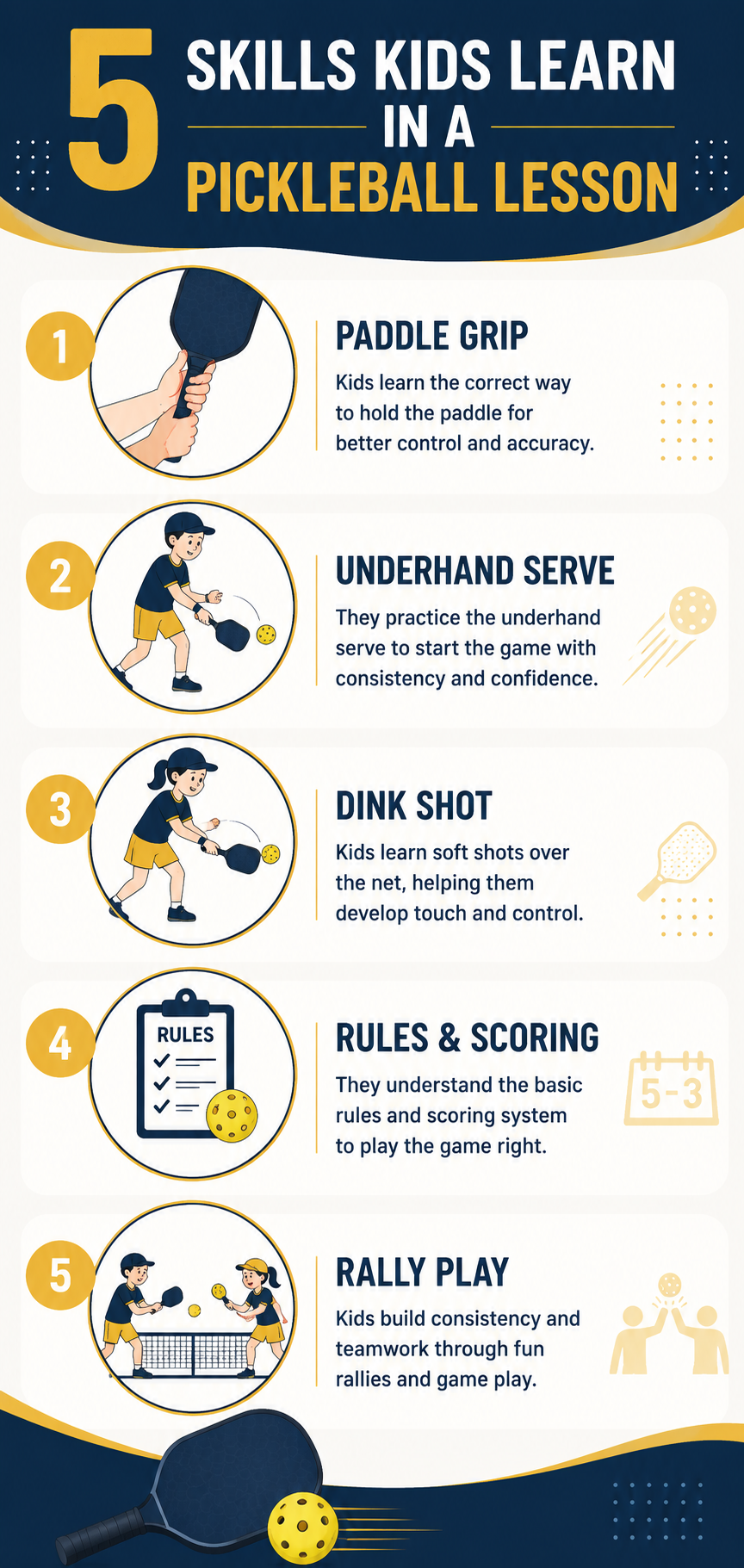
A well-structured pickleball lesson for beginners introduces skills in a specific order, so kids aren’t overwhelmed trying to learn everything at once.
Paddle Grip Basics for Beginners
Everything starts with how a child holds the paddle. Coaches typically teach a simple, comfortable grip early on, since a proper grip makes every other skill easier to build. Getting this right from the start prevents awkward habits that are harder to correct later.
How to Serve in Pickleball
The underhand serve is one of the first real skills taught in a beginner lesson. Unlike the overhead serve in tennis, pickleball’s underhand serve is far more approachable for young kids who haven’t yet developed the shoulder strength or coordination for an overhead motion.
The Dink Shot and Soft Game Near the Net
Once a child is comfortable rallying, coaches introduce the dink, a soft, controlled shot played close to the net. This teaches touch and control rather than just power, and it’s often where kids start to feel like they’re actually playing strategic pickleball rather than just hitting the ball back and forth.
Pickleball Rules and Scoring Explained for Kids
Pickleball’s rules, including the “kitchen” (the no-volley zone near the net) and the two-bounce rule, take a little getting used to. A good beginner lesson explains these clearly and reinforces them through actual play, rather than expecting a child to memorize a rulebook before ever touching a paddle.
Simple Rally and Point Play
Eventually, the individual skills come together into actual rallies and simplified point play, so kids can start applying what they’ve learned in a low-pressure, game-like setting.
Common Mistakes Kids Make Early On, and How Coaching Fixes Them
Even with a naturally gentle learning curve, a few habits tend to show up again and again in kids who are just starting out. Knowing what to watch for helps explain why structured lessons make such a difference early on.
Gripping the paddle too tightly.
A tense, white-knuckle grip is one of the most common beginner habits. It limits wrist movement and control, and it tires a child’s hand out much faster than a relaxed grip would. Coaches usually address this early, since a loose, comfortable grip makes every other skill easier to build on top of.
Standing too close to or too far from the net.
New players often struggle with court positioning, either crowding the net and getting caught out of position, or hanging back so far that they can’t reach shorter shots. A coach helps a child develop a feel for where to stand based on where the ball is, rather than picking one spot and staying there the whole game.
Swinging too hard instead of controlling placement.
It’s a natural instinct for kids to want to hit the ball as hard as possible, but pickleball rewards placement and control far more than raw power, especially in the early rally-building stages. Coaching helps redirect that energy toward accuracy, which actually leads to more successful rallies and, ultimately, more fun.
None of these are things a child does wrong on purpose. They’re simply what happens naturally without someone there to notice and gently correct the habit before it becomes automatic.
What to Expect From Your Child’s First Pickleball Lesson
A first lesson is rarely about jumping straight into competitive play. A good coach usually spends the first session getting a sense of where a child is starting from, their comfort with the paddle, their basic coordination, and how they respond to instruction, before building from there.
Group Pickleball Lesson vs Private Pickleball Lesson for Kids
Both formats work well, depending on your child’s personality and goals. A group pickleball lesson for kids offers a social, class-like environment where children still get individual corrections but also benefit from being around other kids their age.
A private pickleball lesson for kids offers more concentrated, one-on-one attention, which can be a good fit for a child who wants faster progress or who does better with more direct guidance.
What to Bring to a Pickleball Lesson
Most programs provide loaner paddles for beginners, so you don’t need to buy equipment before you’re sure your child will stick with it. Comfortable athletic clothing and proper court shoes are usually all that’s needed.
If your child does end up wanting their own paddle down the line, a lightweight junior paddle designed specifically for kids’ hands makes a real difference compared to using an adult paddle that’s too heavy or too large to control comfortably.
Pickleball Lesson vs Tennis Lesson for Kids: What’s the Difference?
This is a common question for parents weighing their options. The core difference comes down to the equipment and pace. A tennis lesson typically involves a full-sized racquet, a faster-moving ball, and a larger court, all of which can be genuinely challenging for a young beginner to manage at first.
A pickleball lesson uses a smaller paddle, a slower, more predictable ball, and a much smaller court, which tends to make it easier for kids to learn and start rallying sooner.
Neither sport is objectively better. Some kids do wonderfully starting with tennis, especially if they’re a bit older or already showing strong coordination. But for younger kids or those who might get discouraged by a steeper initial learning curve, pickleball is often the gentler entry point into racquet sports, and many of the skills transfer nicely if they want to try tennis later on.
How to Choose a Pickleball Lesson for Your Child
Not every program is structured the same way, so here’s what actually matters when you’re comparing options.
Age-appropriate equipment.
A good program uses lightweight paddles sized for kids’ hands, not scaled-down adult gear that’s still too heavy or awkward to control comfortably.
Coaches with real experience teaching young beginners.
Teaching a motivated ten-year-old and teaching a distractible six-year-old require genuinely different approaches. Look for coaches who are specifically comfortable and patient with true beginners.
Fun-first, low-pressure pacing.
Programs that introduce competitive pressure too early tend to lose kids’ interest faster. The early goal should be building comfort and enjoyment, not producing a competitive player right away.
A path to keep progressing.
A good program should have a clear next step as your child’s skills improve, rather than leaving them stuck repeating the same beginner content indefinitely.
Pickleball Lessons for Kids in London, Ontario
If you’re a parent in the London, Ontario area looking for pickleball lessons for kids, Champion Sports Academy runs beginner-friendly programs built specifically around young players, with age-appropriate equipment and coaches experienced in working with true beginners. If your child hasn’t decided whether pickleball is their thing yet, our summer camp is a great low-pressure way to try it alongside a few other sports before committing to a specific program.
Ready to get your child started? Book a trial lesson or get in touch with our team to ask about age groups, schedules, and which class might be the best fit.
Frequently Asked Questions
What happens in a first pickleball lesson?
A first lesson usually starts with a coach assessing a child’s comfort with the paddle and basic coordination, then introducing grip basics and simple rallies before moving into more structured skills.
What age can kids start pickleball lessons?
Many kids can begin with basic paddle skills and modified rules as young as five or six, though most structured beginner programs typically start around age seven or eight, once hand-eye coordination is a bit more developed.
Do kids need their own paddle for a lesson?
Not usually. Most beginner programs provide loaner paddles so a child can try the sport before you invest in their own equipment.
Is pickleball good exercise for kids?
Yes. Pickleball offers real cardiovascular exercise along with coordination and agility benefits, all with a lower physical impact than many traditional youth sports, since the smaller court reduces the amount of running required.
The Sport That Makes Winning Feel Possible Early
One of the quiet advantages of pickleball for kids is how quickly they start to feel genuinely good at it. The learning curve is gentle enough that most kids are rallying with real confidence within just a few lessons, and that early success tends to build a lasting enthusiasm for the sport rather than the frustration that can come with steeper learning curves elsewhere.
If your child is curious about racquet sports but hasn’t found the right entry point yet, a pickleball lesson might be exactly the low-pressure, high-reward starting place they need.
Disclaimer: This article is intended for general informational purposes only and does not constitute professional coaching or medical advice. Consult a qualified coach before starting a new sport and a healthcare professional before beginning any new physical activity, especially if your child has an existing injury or medical condition.