
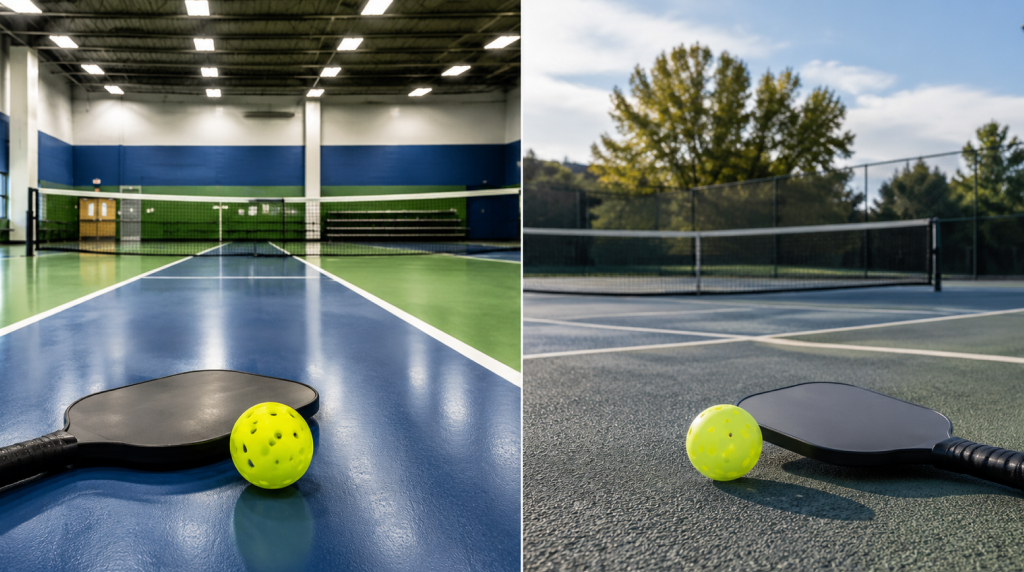
Pickleball has exploded in popularity across Southwestern Ontario over the past few years, and one of the first questions new players run into is whether to play indoors or outdoors. It seems like a small decision at first, but the two environments genuinely play differently.
The ball behaves differently, the paddle feel changes, the pace shifts, and in a city like London where winters are long and summers are short, the choice often isn’t really a preference at all, it’s a scheduling reality.
This guide breaks down what’s actually different between indoor and outdoor pickleball, which is better suited to beginners, and how to think about booking a court depending on the time of year.
If you’ve only ever played one format, the switch to the other can genuinely feel like learning part of the game over again. That’s not an exaggeration. Players who are used to the fast, lively bounce of an outdoor ball often find themselves badly misjudging shots the first time they step onto an indoor court, and the reverse happens just as often.
Understanding why that happens, and which environment actually suits your goals, makes the whole decision a lot less confusing.
Indoor vs Outdoor Pickleball: What’s Actually Different?
At a glance, pickleball looks the same everywhere, same size court, same net height, same basic rules. But once you actually play both environments, the differences become obvious fast.
Indoor vs Outdoor Pickleball Ball
This is the single biggest difference between the two formats, and it comes down to engineering, not just marketing. According to a detailed breakdown of ball design from PickleballUS, indoor pickleballs typically have 26 larger holes, while outdoor balls have 40 smaller holes, a difference of roughly 40 percent in hole diameter.
The reasoning is entirely practical. Indoor courts have no wind to fight, so indoor balls are built lighter and softer, optimized for predictability and control on smooth gym or sport court flooring.
Outdoor balls need more holes and a harder, heavier construction specifically to resist wind and hold a straighter trajectory across a windy outdoor court.
This isn’t a small cosmetic difference either. Outdoor balls tend to fly faster and bounce higher, while indoor balls feel noticeably softer and slower off the paddle. If you’ve only ever played with one type, switching to the other for the first time can genuinely throw off your timing for the first few rallies.
The weight difference compounds this further. Because indoor balls have larger holes, they carry less overall material and end up noticeably lighter than outdoor balls, which are built with thicker, harder plastic specifically to handle temperature swings, rough court surfaces, and constant wind exposure.
A heavier, harder outdoor ball also tends to be louder on contact, which is worth knowing if you’re playing somewhere with noise-sensitive neighbours, while the lighter indoor ball produces a noticeably softer sound off the paddle.
Indoor vs Outdoor Pickleball Paddle
Paddles themselves are largely interchangeable between indoor and outdoor play, but plenty of players notice that a slightly heavier or more control-oriented paddle performs better outdoors against wind resistance, while a lighter, more maneuverable paddle can feel more responsive indoors where quick reaction time matters more than raw power.
It’s a smaller factor than the ball difference, but worth knowing if you’re shopping for your first paddle and plan to play in both settings.
If you do end up splitting your time fairly evenly between indoor and outdoor courts, it’s usually not necessary to own two separate paddles just for that reason. Most mid-range paddles perform reasonably well in both environments, and the ball itself accounts for the bulk of the difference in how a game actually feels.
Where paddle choice starts to matter more is once you’re playing regularly enough to notice small performance differences, at which point a slightly heavier paddle for outdoor wind resistance can genuinely help maintain control on windier days.
Pickleball Court Surface Differences
Indoor courts are almost always a smooth, consistent surface, hardwood or sport court tile, which creates predictable, even bounces. Outdoor courts are typically asphalt or concrete, which can vary in texture, develop cracks over time, and behave differently depending on temperature and weather exposure. A true bounce indoors versus a slightly unpredictable one outdoors is part of why the two environments feel so different, even when the rules are identical.
Surface temperature plays a role too. An outdoor asphalt court that’s been sitting in direct summer sun can genuinely change how the ball bounces compared to the same court on a cooler, overcast morning, since heat affects both the court surface and the ball’s plastic compound.
Indoor courts don’t have that variability at all, which is part of why serious players often use indoor sessions specifically to work on technical consistency, where the only variable changing is their own form.
Is Indoor or Outdoor Pickleball Better for Beginners?
For most beginners, indoor pickleball tends to be the easier starting point. The lighter, softer ball moves slower and bounces more predictably, which gives new players more time to react and build confidence with basic paddle control. There’s also no wind to compensate for, which removes one entire variable that beginners otherwise have to learn to account for.
That doesn’t mean outdoor pickleball is a bad choice for a beginner, plenty of people learn perfectly well outside. But if you’re specifically trying to build fundamentals, like a clean dink shot or a consistent serve, doing that work indoors first, where the ball behaves consistently, tends to make the learning curve a bit gentler.
Once those fundamentals feel solid, transitioning outdoors becomes a much smaller adjustment than trying to learn the sport from scratch while also fighting wind and an unfamiliar bounce at the same time.
Coaches who work with true beginners often find that starting indoors also helps with something less obvious than ball control, confidence.
A new player who can consistently return a shot indoors, without wind throwing off their timing, tends to stick with the sport longer than someone who gets discouraged early by outdoor conditions they weren’t ready to handle yet.
Playing Pickleball in the Wind and Weather
Wind is the single biggest variable in outdoor pickleball, and it affects far more than just long shots. Even a light breeze can meaningfully change the trajectory of a soft dink or a high-arcing shot near the net, which is exactly why outdoor balls are engineered with more, smaller holes in the first place, to fight that instability. Playing outdoors on a windy day essentially adds an extra layer of unpredictability that indoor play simply doesn’t have.
Weather brings its own set of practical considerations too. Rain obviously ends an outdoor session immediately, since a wet court surface becomes unsafe and the ball itself performs unpredictably when damp.
Temperature swings also affect outdoor ball performance, since the plastic compound used in outdoor balls behaves differently in cold versus warm conditions. None of this is an issue indoors, where climate control keeps conditions consistent regardless of what’s happening outside.
For players who want the most consistent, predictable experience possible, particularly while still building fundamentals, that consistency is a real point in favor of indoor play, at least until wind and weather stop feeling like something you need to actively compensate for.
Can You Play Pickleball Indoors Year-Round?
This is where the decision becomes especially relevant for anyone playing in London, Ontario. According to climate data for the region, London typically sees around 84 days a year with at least a centimetre of snow on the ground, with snow cover building from late December through the end of March, and roughly 57 frosty days annually where temperatures stay below freezing all day.
That’s a genuinely long stretch of the year where outdoor pickleball simply isn’t an option, whether or not you’re willing to brave the cold, since ice and snow accumulation make outdoor courts unsafe and often unplayable entirely.
Indoor facilities solve that problem completely, offering consistent, climate-controlled play regardless of what’s happening outside.
For a sport that’s genuinely fun to play regularly, losing four or five months of the year to weather is a real limitation, and it’s the single biggest practical argument in favour of having reliable indoor access, even for players who strongly prefer the outdoor experience the rest of the year.
Even outside of winter, indoor courts remove the guesswork around weather entirely. No more checking the forecast before booking a session, no more games cut short by an afternoon thunderstorm, and no scrambling to reschedule because of wind gusts that make the ball impossible to control.
For anyone trying to build a consistent, regular pickleball habit rather than a seasonal one, indoor play offers a level of reliability that outdoor courts simply can’t match for a large part of the year in this region.
Indoor Pickleball for Kids: Is It the Better Starting Point?
For young players specifically, indoor pickleball often makes even more sense as a starting point than it does for adults. The lighter, slower-moving indoor ball is easier for a child to track and return, and the absence of wind removes one more variable that could otherwise make an already new skill feel harder than it needs to be.
If you’re weighing pickleball lessons for your child, starting them indoors first, where the ball behaves consistently and the court surface stays predictable, tends to build confidence faster than throwing them straight into outdoor conditions with wind and inconsistent bounce to contend with.
Indoor facilities also tend to offer more structured, weather-independent scheduling, which matters a lot for parents trying to fit lessons around school and other activities without worrying about rainouts or cancelled sessions.
How to Book an Indoor or Outdoor Pickleball Court
Booking logistics differ a bit between the two formats. Outdoor courts are frequently free, first-come-first-served public courts in parks and municipal facilities, which means availability can be unpredictable, especially during peak summer hours when everyone else has the same idea.
Showing up on a warm Saturday afternoon without a reservation often means waiting for a court to open up, and there’s no guarantee of how long that wait will be.
Indoor courts, on the other hand, are typically run through a private facility with scheduled time slots, which means guaranteed access once you’ve booked, without needing to show up early and hope a court is free.
This matters more than it might seem for anyone juggling a busy schedule, since knowing exactly when your court time starts and ends makes it far easier to plan lessons, practice sessions, or games around work, school, or other commitments.
If consistency and guaranteed play time matter to you, particularly if you’re trying to fit pickleball around a busy schedule, booking an indoor court in advance tends to be the more reliable option, rather than relying on outdoor courts being available whenever you happen to be free.
Many players find that a mix of both works best in practice, booking indoor time for structured lessons or reliable weekly games, while treating outdoor courts as a more casual, drop-in option when the weather cooperates and their schedule is a bit more flexible.
Indoor vs Outdoor Pickleball Courts in London, Ontario
If you’re trying to decide between indoor and outdoor pickleball in the London, Ontario area, the honest answer is that both have their place depending on the season and your goals.
Champion Sports Academy offers indoor pickleball programs that give you consistent, weather-independent access to the sport year-round, which is especially useful once outdoor courts become unusable through the winter months.
If you’re specifically looking for outdoor options during the warmer months, our guide to outdoor pickleball courts that allow private lessons covers where to find them locally.
Many players in London end up doing both, outdoor pickleball through the summer when the weather cooperates, and indoor pickleball the rest of the year to keep their game consistent without a long winter break resetting their progress.
Ready to book a court in London?
Book an indoor court today or get in touch with our team to talk through availability, scheduling, and which option fits your goals best.
Frequently Asked Questions
Is indoor or outdoor pickleball harder?
Outdoor pickleball tends to be slightly harder for beginners, mainly due to wind affecting shot trajectory and the ball’s faster, higher-bouncing nature. Indoor pickleball’s slower, softer ball generally makes it easier to build fundamentals before transitioning outdoors.
Does wind affect outdoor pickleball?
Yes, significantly. Even a light breeze can change the flight path of a dink shot or a high, arcing return, which is exactly why outdoor balls are specifically engineered with more, smaller holes to help resist wind and maintain a straighter trajectory.
Can you play pickleball indoors year-round?
Yes. Indoor facilities offer consistent, climate-controlled play regardless of season, which is especially valuable in a region like London, Ontario, where winter weather makes outdoor pickleball impractical for several months of the year.
What’s the difference between an indoor and outdoor pickleball ball?
Indoor balls have fewer, larger holes and a lighter, softer construction designed for predictable play on smooth indoor surfaces. Outdoor balls have more, smaller holes and a harder, heavier construction built specifically to resist wind and perform on rougher outdoor court surfaces.
The Best Court Is the One You’ll Actually Show Up To
At the end of the day, the indoor versus outdoor pickleball debate isn’t really about one format being definitively superior. Outdoor courts offer fresh air, natural light, and a completely free way to play during the warmer months.
Indoor courts offer consistency, predictability, and the ability to keep playing regardless of what the weather decides to do, which matters enormously in a city where winter takes up a real chunk of the calendar.
The better question isn’t which one wins on paper. It’s which option actually fits your schedule, your skill level, and your willingness to play through a stiff breeze or a cold morning.
For a lot of players in London, the real answer ends up being both, outdoors when the season allows it, and indoors the rest of the time to keep the game going year-round.
Whichever format you end up favouring, the most important thing is simply staying consistent. A sport like pickleball rewards repetition, and the players who improve fastest tend to be the ones who find a way to keep playing regularly, rather than the ones who happen to have access to the “better” court.
If that means chasing sunny days outdoors through the summer and shifting to a reliable indoor facility once the weather turns, that’s a perfectly reasonable way to play the sport well all year long.